
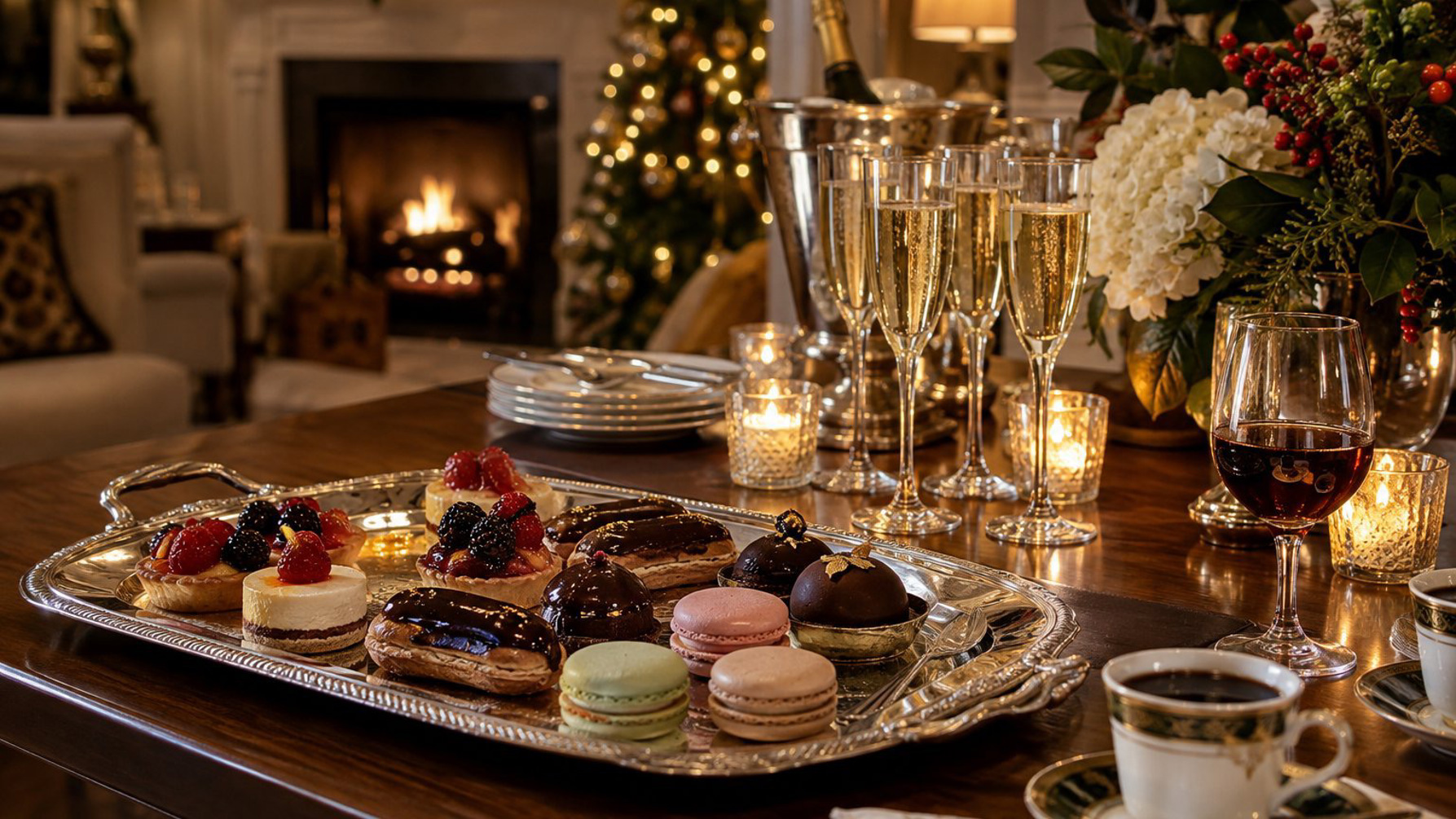
Wine & Coffee Pairings for French Pastries in Lafayette
Key Takeaways
- The golden rule of dessert pairing: the drink should be at least as sweet as the pastry, or the wine will taste thin and sour next to it.
- Bright, acidic wines and sparkling wines suit fruit tarts and cream tarts, while fortified wines like tawny port stand up to chocolate mousse and pecan flavors.
- A dry Brut Champagne toast often clashes with sweet desserts; a demi-sec, Moscato d'Asti, or a slightly sweeter sparkling wine is the safer match at a wedding.
- Coffee is the easiest all-purpose partner for French pastries in Lafayette, LA — and South Louisiana's chicory coffee tradition pairs especially well with éclairs and cheesecake.
Anyone who has hosted a holiday open house, a rehearsal dinner, or a wedding reception in Acadiana knows the dessert table is where people gather and stay. What ends up in their glass while they're there matters more than most hosts realize. The right wine can make a fruit tart taste brighter, and the wrong one can make a beautiful chocolate mousse dome taste oddly bitter.
The good news is that pairing drinks with French pastries isn't complicated once you understand a few principles. Below is a practical guide to wine, Champagne, and coffee pairings for French pastries in Lafayette, LA, whether you're planning a holiday party in Broussard, a bridal shower in Youngsville, or simply setting out a pastry sampler for family.
The Basic Rules of Wine and Pastry Pairing
The most important rule of wine and pastry pairing is that the wine should be as sweet as, or sweeter than, the dessert. When a dry wine meets sugar, the wine's fruit disappears and its acidity and alcohol take over, tasting sharp. After sweetness, match intensity: light pastries call for delicate wines, rich ones for fuller wines.
Sommeliers lean on three further ideas when building a dessert pairing:
- Acidity loves fruit. Pastries built on fresh berries, citrus curd, or stone fruit pair best with wines that have bright, refreshing acidity, so the drink doesn't feel flat next to the fruit.
- Bubbles cut richness. Carbonation scrubs the palate after butter and cream, which is why sparkling wine is so forgiving with pastry cream, mousse, and buttery tart shells.
- Bridge the flavors. Look for a shared note — caramel with caramel, nutty with nutty, red fruit with red fruit. A tawny port's toasted-nut character, for example, echoes pecans and brown butter.
Tannin is the one thing to be cautious with. Big, dry red wines like Cabernet Sauvignon tend to taste harsh and astringent alongside most desserts, including chocolate. If a guest insists on red, a sweet red is a better bet.
Wine Pairings for Classic French Pastries
The best wine pairings for French pastries follow the pastry's main flavor. Fruit tarts suit Moscato d'Asti or late-harvest Riesling, cream-based pastries suit Sauternes, chocolate mousse suits tawny port or Banyuls, and chocolate-covered strawberries suit Brachetto d'Acqui. Each pairing matches sweetness first, then echoes a shared flavor.
Fruit tarts and cream tarts
A fresh fruit tart layers crisp pâte sucrée, vanilla pastry cream, and glazed fruit, so it needs a wine with both sweetness and lift. Moscato d'Asti, a lightly sparkling Italian wine at around 5.5% alcohol, is a near-perfect match: gentle, peachy, and refreshing. Late-harvest Riesling works beautifully too, especially with citrus or berry tarts. Cream tarts, which lean richer and more custard-forward, pair well with a demi-sec sparkling wine whose bubbles keep each bite feeling light.
Éclairs, petit fours, and cheesecake
Choux pastry filled with vanilla or coffee cream loves a honeyed dessert wine. Sauternes, from the Bordeaux region of France, has notes of apricot, honey, and toasted nuts that complement pastry cream and caramelized icing. For petit fours with almond sponge and fondant, a Vin Santo or a late-harvest Sauvignon Blanc picks up the almond character. Cheesecake, with its tangy richness, pairs nicely with an ice wine or a late-harvest Riesling, whose acidity balances the cream cheese.
Chocolate mousse domes and mousse cakes
Chocolate is the trickiest flavor to pair because it coats the palate and carries its own bitterness. Fortified wines handle it best. Tawny port brings caramel and walnut notes, while Banyuls — a sweet red from southern France — is a classic French partner for dark chocolate. Lighter milk-chocolate or white-chocolate mousse cakes pair well with a ruby port or even an off-dry sparkling rosé.
Chocolate-covered strawberries and macarons
Brachetto d'Acqui, a sweet, lightly sparkling red from Piedmont, tastes like fresh strawberries and roses, making it the textbook match for chocolate-covered strawberries. Macarons vary by flavor: raspberry and passion fruit macarons love sparkling rosé, pistachio and salted caramel pair with tawny port, and lemon macarons pair with Moscato.
Champagne and Dessert Pairing for Weddings
For weddings, the most common pairing mistake is serving dry Brut Champagne with the dessert course. Brut is wonderful for the toast, but next to sweet pastries it can taste sour. If you want bubbles with dessert, offer a demi-sec Champagne, Moscato d'Asti, or an extra-dry Prosecco, which carry enough sweetness.
Many couples in Lafayette Parish time the toast to coincide with dessert, which is when this clash shows up. There are a few easy ways around it:
- Separate the toast and dessert. Toast with Brut during dinner, then open the dessert table afterward with coffee and a sweeter wine.
- Choose a sweeter sparkling wine for the toast. Demi-sec and "extra dry" labels (which, confusingly, are sweeter than Brut) bridge both moments.
- Lean the display toward fruit. Fruit tarts, raspberry macarons, and lemon cream tarts are the most Brut-friendly pastries thanks to their acidity.
For quantity planning, a standard 750 ml bottle pours about six to eight toast-sized glasses of sparkling wine, or about five full 5-ounce glasses. Dessert wines are typically served in smaller 2- to 3-ounce pours, so a 375 ml half-bottle of Sauternes or port can serve four to six guests. If you're building a wedding dessert display, share your drink menu with your pastry chef early so flavors can be balanced toward what will be in guests' glasses.
Coffee Pairings: The Louisiana Favorite
Coffee is the most versatile partner for French pastries because its bitterness balances sugar and its roasted notes complement butter, chocolate, and caramel. Espresso suits macarons and chocolate, café au lait suits éclairs and fruit tarts, and South Louisiana's coffee-and-chicory blends pair beautifully with cheesecake and pecan flavors.
Coffee culture runs deep in South Louisiana. Chicory root was added to coffee in the region during shortages in the 1800s, and many families from Carencro to New Iberia still prefer its rounder, slightly woody, almost cocoa-like flavor. That earthiness is a natural match for rich pastries:
- Espresso — intense and concentrated; ideal with macarons, chocolate mousse domes, and petit fours, where a small sip resets the palate between sweet bites.
- Café au lait — half coffee, half scalded milk, the way it's been served in Louisiana for generations; gentle enough for éclairs, cream tarts, and fruit tarts.
- Dark roast with chicory — bold and slightly bittersweet; excellent with cheesecake, praline or pecan flavors, and chocolate-covered strawberries.
- Light roast pour-over — bright and fruity; a lovely non-alcoholic match for berry tarts and lemon pastries.
For guests who don't drink alcohol, a coffee bar is often the most memorable part of a dessert table. Hot tea works too: Earl Grey's bergamot complements lemon and berry pastries, while a jasmine green tea is delicate enough for vanilla macarons.
Setting Up a Pastry Pairing Table at Home or an Event
A successful pairing table offers two or three drinks, not ten. Choose one sparkling option, one dessert wine, and coffee, then arrange pastries so each drink sits near its best matches. Small pours and bite-sized pastries let guests try several combinations without feeling overwhelmed or overserved.
A few practical tips for hosts across Acadiana:
- Serve dessert wines chilled. Sauternes, Moscato, and Riesling show best around 45–50°F; tawny port is best slightly cool, around 55–60°F.
- Label the pairings. A small card reading "Try the Brachetto with a chocolate strawberry" turns a dessert table into a conversation piece.
- Keep cream pastries cold. Food safety guidance from the USDA says perishable foods shouldn't sit at room temperature for more than 2 hours, or 1 hour above 90°F — important at outdoor Louisiana events.
- Offer water. Still water between sips keeps palates fresh and guests comfortable.
At The Rolling Pin, Chef Brad Sonnier II's classical French training — including time as an Assistant Pastry Chef at The Ritz Carlton — shapes how a pastry assortment comes together, with varied flavors, textures, and sweetness levels in every display. If you'd like help choosing pastries to complement your holiday party or wedding drink menu, contact us or call (337) 303-3358.
Frequently Asked Questions
What wine goes best with French pastries?
The best wine for French pastries is one that is at least as sweet as the dessert. Moscato d'Asti and late-harvest Riesling suit fruit tarts, Sauternes suits cream-filled pastries like éclairs, and tawny port or Banyuls suits chocolate mousse. Avoid dry, tannic red wines, which taste harsh next to sugar.
Does Champagne go with wedding desserts?
Dry Brut Champagne often tastes sour alongside sweet wedding desserts. For the dessert course, choose a demi-sec Champagne, Moscato d'Asti, or extra-dry Prosecco instead. If you prefer Brut for the toast, pair it with fruit-forward pastries like fruit tarts or raspberry macarons, whose acidity matches the wine.
What drink pairs well with French macarons?
Espresso is a reliable match for almost any macaron flavor because its bitterness balances the sweet almond shells. For wine, sparkling rosé suits raspberry and fruit macarons, Moscato suits lemon, and tawny port suits pistachio, chocolate, or salted caramel macarons.
What pastries are popular for holiday parties in Louisiana?
Popular holiday party pastries in Louisiana include bite-sized cheesecakes, mini éclairs, chocolate mousse domes, fruit tarts, macarons, and chocolate-covered strawberries, often with pecan, praline, or citrus flavors. Bite-sized pastries are favored because guests can sample several and pair them with coffee or wine.
How much dessert wine do I need for a party?
Dessert wines are served in small 2- to 3-ounce pours, so a 375 ml half-bottle serves about four to six guests and a 750 ml bottle serves about eight to twelve. Not every guest will choose dessert wine, so many hosts plan for roughly half the guest list.

