
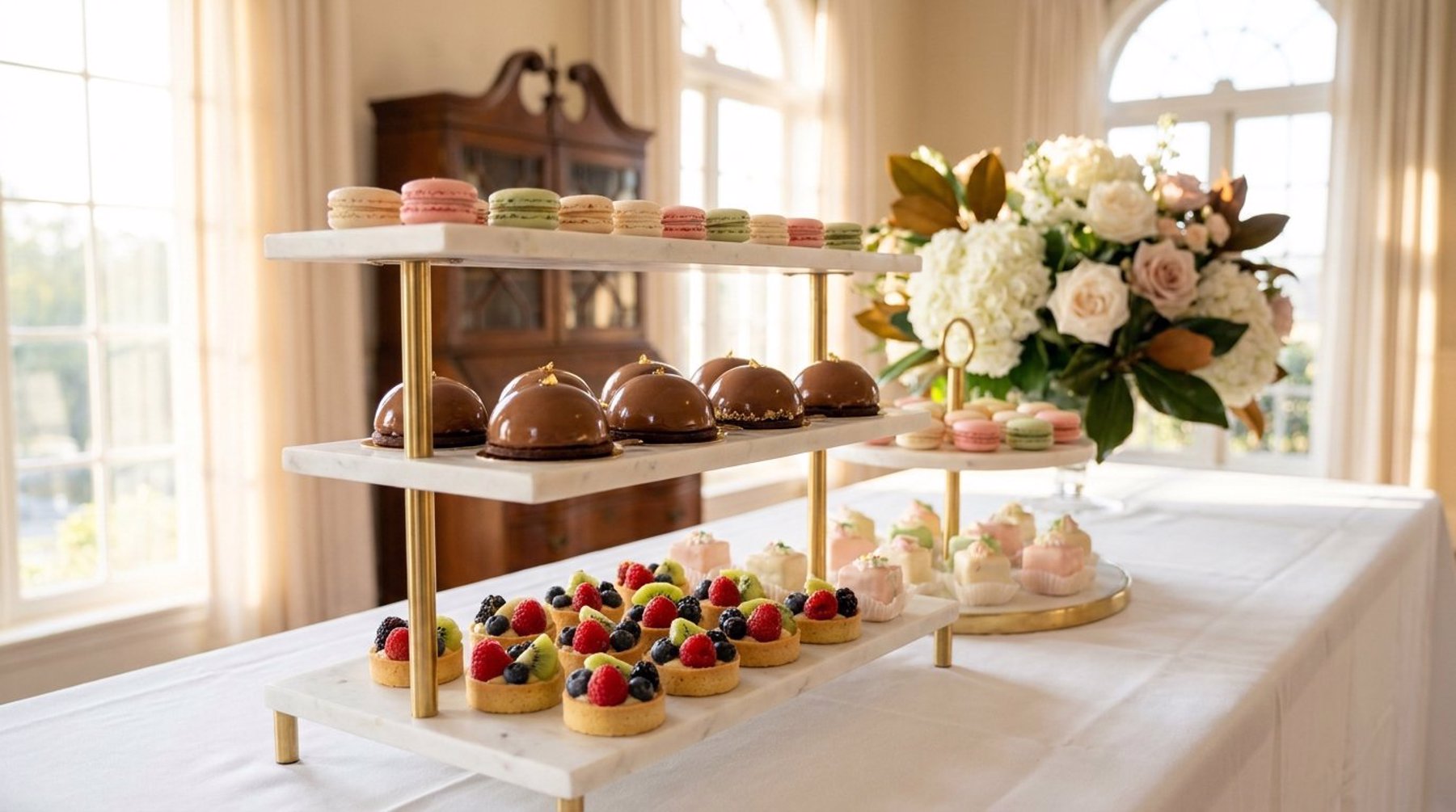
How to Choose a Dessert Caterer in Lafayette, LA
Key Takeaways
- The strongest signal of a good dessert caterer in Lafayette, LA is verifiable pastry training — classical patisserie technique is a learned discipline, not a hobby skill.
- Ask when your desserts will actually be made. Fresh French pastry is finished within 24–48 hours of service, not baked a week ahead and frozen.
- Louisiana humidity and heat break certain desserts. A caterer who plans around that with ganache, mousse, and tempered chocolate instead of soft buttercream is thinking ahead.
- Compare quotes by cost per piece and per guest, not by total price — and confirm delivery, setup, insurance, and rental returns are in writing before you book.
Choosing a dessert caterer feels simple until you start making calls. Everyone's photos look beautiful. Everyone says they use quality ingredients. And unlike a florist or a photographer, you usually cannot judge the work until it is sitting on a table in front of 150 guests. The difference between a great dessert spread and a disappointing one is almost always decided in the questions you ask before signing anything — training, freshness, logistics, pricing structure, and the contract details that quietly cause problems on event day.
How Do You Choose a Dessert Caterer in Lafayette, LA?
Choose a dessert caterer in Lafayette, LA by verifying four things: the pastry chef's formal training, when the desserts are produced relative to your event, how delivery and setup are handled in Louisiana heat, and whether pricing is transparent per piece. A caterer who answers all four clearly and specifically is almost always the safer booking.
Those checks matter because dessert catering sits at an awkward intersection of craft and logistics. The pastry demands genuine technique — a macaron shell that domes properly, a mousse that sets without weeping, chocolate tempered to snap rather than smear. The delivery side demands operational discipline: a 200-piece display has to arrive intact, cold, and arranged beautifully in a tight window while a venue coordinator manages six other vendors.
Plenty of home bakers execute one of those halves well. Fewer do both consistently. So while you are looking at portfolios, notice whether the person you are talking to speaks fluently about both the kitchen and the event floor.
Look for Real Pastry Training, Not Just Pretty Photos
Formal pastry training is the single most reliable indicator of consistency. Classical French patisserie is built on standardized methods — pâte à choux, pâte sucrée, Italian meringue, chocolate tempering curves — that take structured instruction and repetition to master. A trained pastry chef produces the same result in July that they produced in January.
Ask directly where a caterer learned to bake. Culinary school, a pastry-specific program, or time in a hotel or restaurant pastry department all count — the last especially, because the volume is relentless and standards are enforced daily. Plenty of self-taught bakers do lovely work, but training buys you predictability under pressure.
It shows up in the range of the menu, too. Someone who produces éclairs, macarons, fruit tarts, petit fours, and mousse cakes at the same quality level has a broad technical base. A portfolio that is entirely one item tells you where the skill ends.
What credentials actually mean something
- Classical pastry instruction — a dedicated patisserie program, not a general cooking course
- Professional kitchen experience — hotel, resort, or fine-dining pastry departments demand volume and consistency
- A Louisiana Department of Health permit — any caterer producing food for public events should be operating out of a permitted commercial kitchen
- Liability insurance — most Lafayette Parish venues require a certificate of insurance from every vendor on site
That last pair is worth a direct question. Many venues around Lafayette, Broussard, and Youngsville will not let an uninsured vendor load in at all.
Ask When Your Desserts Will Actually Be Made
Fresh French pastry is assembled close to service — typically within 24 to 48 hours of your event. Components like macaron shells and tart crusts may be baked slightly earlier, but filled, glazed, and fruit-topped pastries degrade quickly. If a caterer cannot tell you their production timeline, that is worth pressing on.
The reason is structural, not fussy. Pâte à choux — the dough behind éclairs and cream puffs — is hygroscopic, meaning it pulls moisture from the air and from whatever it is filled with. A filled éclair that sat overnight goes from crisp to soft and slightly leathery. Fresh fruit on a tart begins releasing juice into the pastry cream within hours unless the shell is sealed with a chocolate or glaze barrier. Macarons are the exception that proves the rule: they improve with 24 to 48 hours of refrigerated maturation as moisture migrates from the filling into the shell, which is why a chef who understands them schedules them differently.
Freezing is not automatically a red flag — unfilled macaron shells and some tart bases freeze well, and any high-volume kitchen uses that to manage a busy weekend. What matters is the honest answer about what gets frozen and what does not.
Confirm How They Handle Louisiana Heat and Humidity
South Louisiana weather is a real technical constraint, and the best dessert caterers in Acadiana build their menus around it. Ambient summer humidity above 70% and outdoor temperatures in the 90s will soften American buttercream, dull tempered chocolate, and collapse whipped-cream-based fillings within an hour of setup.
This is where a technically strong caterer earns their fee, because heat-stable choices exist:
- Ganache and mousse fillings hold structure far longer than whipped cream or soft buttercream
- Properly tempered chocolate — cocoa butter crystallized into stable form — resists bloom and softening better than untempered coating chocolate
- Baked and set components like cheesecakes, petit fours, and mousse domes travel and hold better than delicate assembled pastries
- Staged service — holding a portion of the display in a cooler and replenishing the table mid-reception rather than putting everything out at once
Ask specifically: how do you keep the display cold at an outdoor reception in August, and do you stay for setup or drop and leave? For an outdoor wedding anywhere from Duson to New Iberia, a caterer who has thought this through answers immediately. One who has not gets vague.
Food safety runs alongside this. Cream-, custard-, and cheese-based pastries are time and temperature controlled foods and should be held at or below 41°F until service. A caterer who talks comfortably about cold-holding has done this at scale.
Compare Pricing the Right Way
Compare dessert catering quotes on a per-piece and per-guest basis rather than by total price. Bite-sized pastry catering in the Lafayette area is generally priced by count, so converting every quote into cost per piece makes wildly different-looking proposals directly comparable — and reveals what is actually included.
Three questions surface the real number. Is delivery, setup, and display styling included or billed separately? Are stands, tiers, and platters provided, and who returns them? Is there a minimum order or travel charge for venues outside Lafayette proper? A quote that looks $200 cheaper often loses that edge once a delivery fee and rental deposit appear.
It is also worth understanding what you are not paying. Many Acadiana venues charge a per-slice cake-cutting fee, which can add $150 to $300 to a traditional cake bill. Bite-sized pastries are served as-is, so that line item usually disappears — a real cost difference that rarely shows up when you are comparing quotes side by side. If you are still weighing formats, our wedding pastry catering page covers how displays compare to a tiered cake.
Questions to Ask Before You Book
Bring a short list to every consultation. The goal is not to interrogate anyone — it is to hear how concretely each caterer answers.
- Where did you train, and how long have you been catering events in this area?
- When will my desserts be produced, and what is assembled fresh versus prepared ahead?
- Do you deliver and set up, and do you stay to style the display?
- How do you handle heat and humidity at an outdoor Louisiana venue?
- Can you accommodate allergies or dietary needs, and how do you prevent cross-contact?
- What is the cost per piece, and what is included in that number?
- How many pieces do you recommend per guest for my guest count?
- What is your deposit, final headcount deadline, and cancellation policy?
- Can I taste before I commit?
That last one carries more weight than any photograph. A tasting tells you about texture, sweetness balance, and whether the almond flour in a macaron tastes fresh or stale — things no portfolio can convey.
At The Rolling Pin, Chef Brad Sonnier II trained in classical French pastry at L'Academie De Cuisine in Maryland, earned a Culinary Arts degree in New Orleans, and worked as an Assistant Pastry Chef at The Ritz Carlton before returning home to Louisiana — which is exactly the kind of background worth asking any caterer about. You can see the full range of bite-sized French pastries we produce, or reach out at (337) 303-3358 to talk through your event and schedule a tasting.
Frequently Asked Questions
How far in advance should I book a dessert caterer in Lafayette?
Book a dessert caterer four to six months ahead for a wedding and three to four weeks ahead for a smaller party or corporate event. Peak season in Acadiana — spring and fall wedding months, plus December holiday parties — fills earliest, so popular Saturdays can be claimed six to nine months out.
What is the difference between a bakery and a dessert caterer?
A bakery sells finished products from a storefront for pickup. A dessert caterer produces for a specific event and handles quantity planning, delivery, timing, display design, and on-site setup. For a wedding or corporate function, that event logistics layer is usually the more important half of the service.
How many bite-sized pastries should I order per guest?
Plan four to six bite-sized pastries per guest for a wedding reception where dessert is the main sweet course, and three to four per guest for a corporate event or shower with lighter service. A good caterer will adjust that based on your timeline, whether dinner is served, and how long the dessert table stays open.
Can a dessert caterer match my wedding colors and theme?
Yes. French pastries are unusually flexible for color matching — macaron shells, mirror glazes, chocolate décor, and fruit selection can all be tuned to a palette. Share your colors and a few inspiration photos early, since some shades require specific glaze or coloring work that affects production planning.
Are French macarons gluten-free?
Traditional French macarons are made with almond flour, egg whites, and sugar, so the recipe itself contains no wheat. However, they are usually produced in kitchens that also handle wheat flour, so they are not safe for celiac disease without specific cross-contact precautions. Always ask your caterer directly about their kitchen practices.

