
How Many Pastries Per Guest for a Lafayette Wedding?
Key Takeaways
- Plan on 3 to 5 bite-sized pastries per guest when a pastry display is your main dessert, and 2 to 3 per guest when you are also serving a cutting cake.
- Count pieces, not platters. Bite-sized French pastries are one- to two-bite portions, so a "serving" is several pieces rather than a single slice.
- Offer 4 to 6 pastry varieties for most Lafayette receptions — enough range to feel abundant without leaving half-empty trays at the end of the night.
- Add 10 to 15 percent overage for late arrivals, second helpings, and the boxes people quietly take home.
Almost every couple planning a reception in Lafayette Parish hits the same wall at the same moment: the dessert quote asks for a piece count, and nobody has any idea what number to write down. Guest count you know. Entrée count your caterer handled. But how many pastries does 150 people actually eat? Guess low and the display is picked clean before the first dance. Guess high and you are paying for four dozen macarons that ride home in a cooler.
The good news is that dessert quantities follow fairly predictable patterns, and they are easy to reason about once you understand how bite-sized portions differ from cake slices. Here is how professional pastry planning actually works, and what it means for wedding desserts in Lafayette, Louisiana.
How Many Bite-Sized Pastries Do You Need Per Wedding Guest?
Plan on 3 to 5 bite-sized pastries per guest when the pastry display is your primary dessert, and 2 to 3 pieces per guest if you are also cutting a traditional wedding cake. For a 150-guest reception with no cake, that is roughly 450 to 750 pieces. With a cake, 300 to 450 pieces is usually right.
The spread in that range is not vagueness — it tracks real variables. A 9:00 p.m. dessert release after a heavy plated dinner lands at the low end. An afternoon reception with light hors d'oeuvres and an open dessert table for three hours lands at the high end, sometimes above it. Receptions with a lot of children and a lot of guests in their twenties consistently run higher than the average.
Start with the midpoint — 4 pieces per guest — and adjust from there based on your timeline and menu. That single number gets most couples within striking distance before any other detail is settled.
A quick worked example
- 120 guests, pastry display only: 480 pieces at 4 per guest, plus 15 percent overage — order about 550.
- 200 guests, small cutting cake plus display: 500 pieces at 2.5 per guest, plus overage — order about 560.
- 75 guests, afternoon reception, dessert as the centerpiece: 375 pieces at 5 per guest — order about 400.
Why Bite-Sized Desserts Change the Serving Math
Bite-sized French pastries are portioned as one- or two-bite items, which means a single "serving" is a handful of pieces rather than one plated dessert. A traditional wedding cake is cut into slices roughly one inch by two inches — one slice, one guest. A display of macarons, éclairs, and mousse domes works nothing like that, which is why cake-based serving charts mislead people badly.
Scale is part of it. A French macaron shell is typically piped to about 1.5 inches across. Petit fours are cut close to one-inch squares. A chocolate mousse dome or mini cheesecake sits somewhere between a bite and a small dessert. None of those reads as "dessert, finished" to a guest the way a slice of cake does, so people take two or three and come back later.
The behavior is also different. Cake is served to seated guests, once. A pastry display invites grazing — guests visit between dances, on the way back from the bar, and again while the venue is being packed down. Grazing raises per-person consumption while lowering waste, because guests take what they actually want instead of receiving a slice they abandon after two bites. That is a large part of why bite-sized wedding pastry displays have become so popular across Acadiana receptions.
How Your Reception Timeline Affects the Count
Dessert consumption is driven more by timing than by guest count. Desserts set out at the start of the reception and left open for three or four hours will move 30 to 50 percent more product than the same display released for a 45-minute window after dinner. Decide your service window before you finalize your order.
A few patterns hold consistently at Lafayette, Broussard, and Youngsville venues:
- Open display all evening: highest consumption. Budget 4 to 5 pieces per guest, minimum.
- Released after the cake cutting: moderate. 2 to 3 pieces per guest, since cake absorbs the first wave.
- Late-night dessert with coffee: lower per-guest counts, but heavily skewed toward chocolate and anything paired with coffee.
- Brunch or afternoon reception: unpredictable and often high — lighter food service means dessert carries more of the meal.
Send-off boxes are the other quiet multiplier. If you plan to send guests home with a small box of pastries, that is a separate line item on top of your display count, not something to absorb into it. Two to three pieces per box across 100 boxes is another 250 pieces.
How Many Varieties Should a Dessert Display Include?
Four to six varieties is the sweet spot for most weddings. That is enough contrast in flavor, color, and texture to make a display look abundant, while keeping each individual item plentiful enough that guests arriving late still find some of everything. Under three varieties reads as thin; over eight starts to look scattered and leaves partially cleared trays.
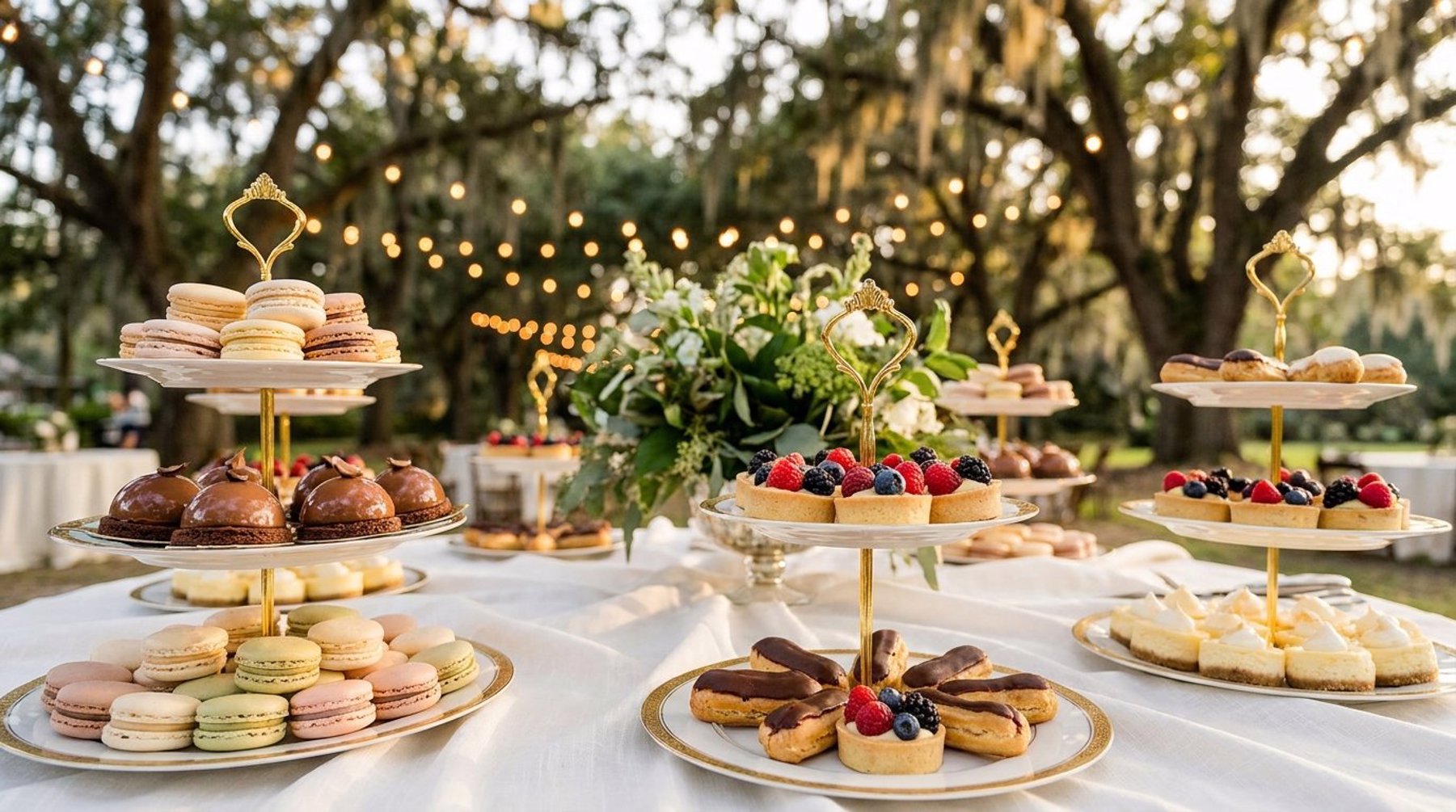
Balance matters more than raw count. A well-built display usually covers four bases: something chocolate, something fruit-forward, something creamy, and something crisp. In practice that might mean chocolate mousse domes, fresh fruit tarts, mini cheesecakes, and French macarons, with chocolate covered strawberries and éclairs rounding it out.
Weight your quantities rather than splitting evenly. Chocolate items and macarons reliably disappear first at South Louisiana receptions, so ordering those at 1.5 times the volume of the others keeps the table looking full deep into the evening. An experienced pastry chef will build that skew into the proposal without being asked.
Planning Around Louisiana Heat and Humidity
Outdoor and semi-outdoor receptions in Acadiana need a display designed for the climate, not just the aesthetic. Summer afternoons here routinely combine temperatures in the low 90s with humidity above 70 percent, and that combination is genuinely hard on pastry. It affects what you order as much as how much.
Meringue-based items soften in high humidity. Soft buttercream loses definition quickly in direct heat. Tempered chocolate, set ganache, mousse, and baked cheesecake all hold their structure far better, which is why heat-season displays in Lafayette tend to lean toward chocolate domes, éclairs with pastry cream, and cheesecakes rather than delicate sugar work.
Practical planning steps that make a real difference:
- Confirm shaded placement and, ideally, indoor or tented service for the dessert table.
- Ask whether your caterer stages desserts in batches rather than setting everything out at once.
- Schedule the dessert release for after sunset when the reception is outdoors in June through September.
- Keep the display away from chafing dishes, heat lamps, and direct fan flow.
Chef Brad Sonnier II founded The Rolling Pin in Duson in 2016 after training in classical French pastry and working as an assistant pastry chef at The Ritz Carlton — and a good deal of that experience goes into deciding which pastries belong on a Louisiana summer table in the first place.
What Per-Guest Counts Mean for Your Dessert Budget
Because pastry catering is priced per piece, your per-guest count is the single biggest lever on your dessert budget. Moving from 5 pieces per guest to 3 across a 175-guest reception removes 350 pieces from the order — a meaningful difference that has nothing to do with quality and everything to do with matching quantity to how your reception actually runs.
That is also why comparing quotes on total price alone is misleading. One proposal at a higher total may simply assume a more generous count. Ask every caterer for cost per piece and total piece count, then compare on the same basis. If a quote comes in surprisingly low, check the piece count before you celebrate.
Where couples find genuine savings is usually in structure rather than volume: a small two-tier cutting cake instead of a four-tier, a display weighted toward fewer varieties in larger quantities, or skipping send-off boxes in favor of a fuller table. If you are working through those trade-offs for a wedding in Lafayette, Duson, or anywhere in Acadiana, call The Rolling Pin at (337) 303-3358 or reach out through our contact page with your guest count and reception timeline — that is enough information to build a realistic piece count.
Frequently Asked Questions
How many bite-sized pastries do I need per wedding guest?
Plan on 3 to 5 bite-sized pastries per guest if the pastry display is your main dessert, or 2 to 3 per guest if you are also serving a cutting cake. Four pieces per guest is a reliable starting point, adjusted up for long open service windows and down for a short post-dinner release.
Do I need a wedding cake if I have a pastry display?
No. Many Lafayette couples skip the cake entirely and serve a pastry display alone. Others order a small two-tier cake purely for the cutting photos and let the display handle actual dessert service, which keeps the tradition without paying to feed 150 guests twice.
How far in advance should I order wedding desserts in Lafayette?
Reach out 4 to 6 months before the wedding, and earlier for spring and fall Saturdays, which book fastest across Acadiana. Final piece counts are typically confirmed 2 to 3 weeks out, once your guest RSVPs have settled.
How many pastry varieties should a wedding dessert table have?
Four to six varieties works for most receptions. Cover something chocolate, something fruit-forward, something creamy, and something crisp, then order chocolate items and macarons in larger quantities since they are consistently the first to go.
What is the best dessert for a summer outdoor wedding in Louisiana?
Choose desserts built on tempered chocolate, set ganache, mousse, or baked cheesecake. Acadiana summer humidity above 70 percent softens meringue and breaks down soft buttercream, while chocolate mousse domes, éclairs, and cheesecakes hold their structure through an evening reception.

